Story
Story Vol.7
Mokei-teki Monozukuri CARVED【vol.2】
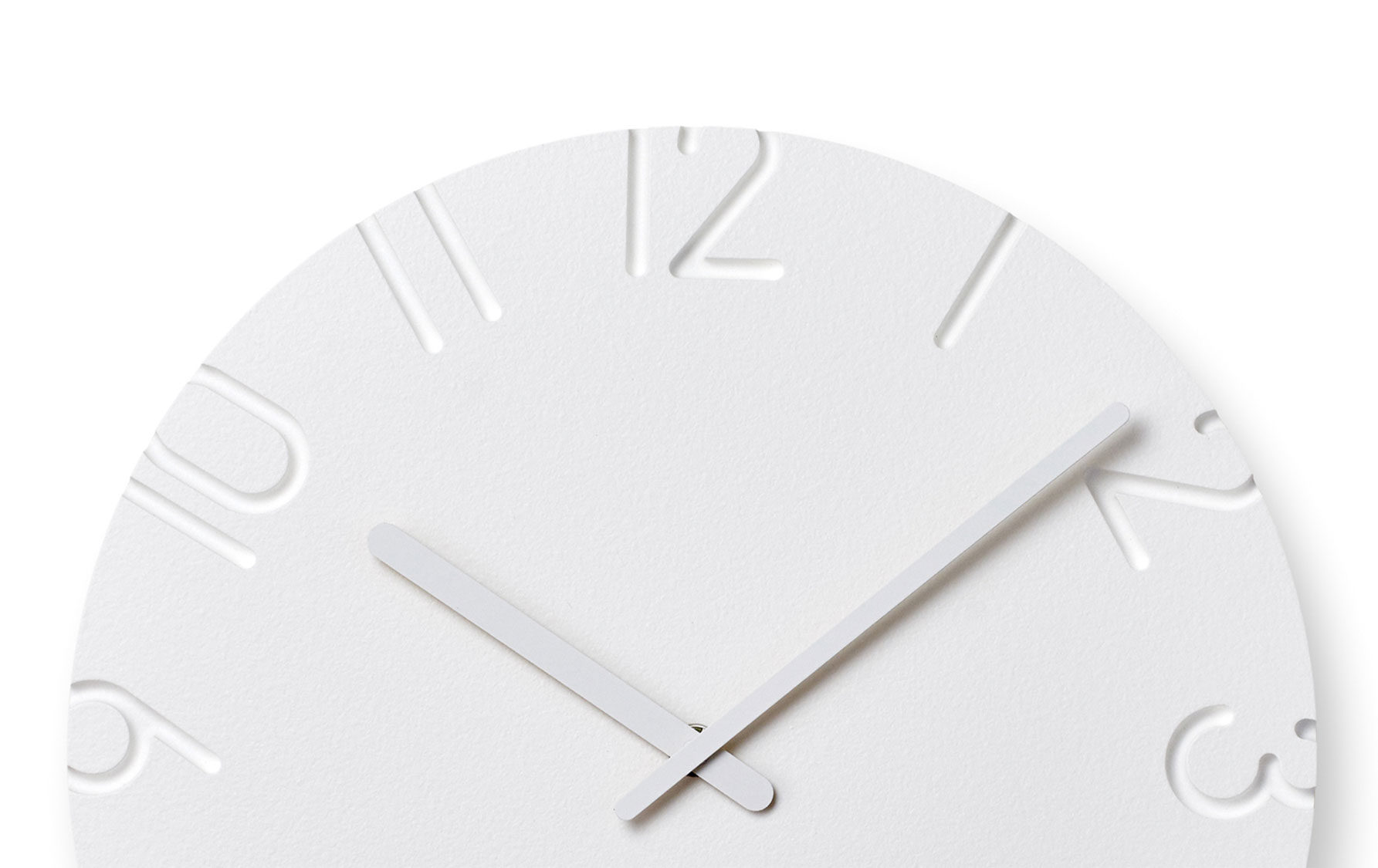
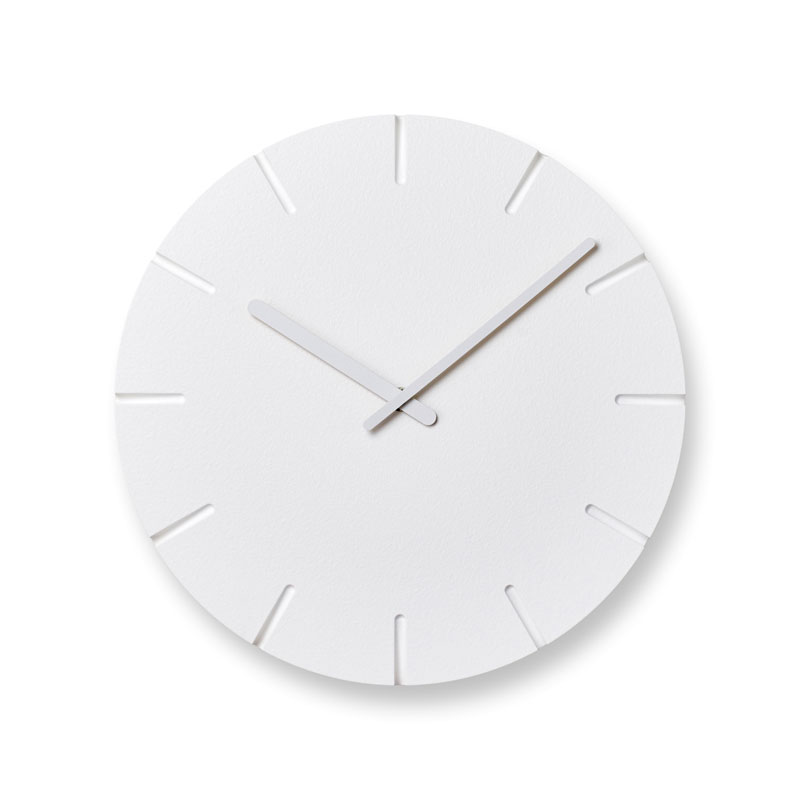
Last time, I started talking about the CARVED wall clock series. Instead of simply pursuing the best graphic for the dial, I paid attention to the wall in the background of the clock and made “texture” the clock theme in order to achieve a balance between the clock and any type of wall. In my search for the most suitable material, I found inorganic artificial wood, which is generally used as an interior decoration material.
「Mac People magazine’s」 April 2013 issue
「Mokei-teki Monozukuri #4-1」 Article
[ Design & Text: Naoki Terada ]
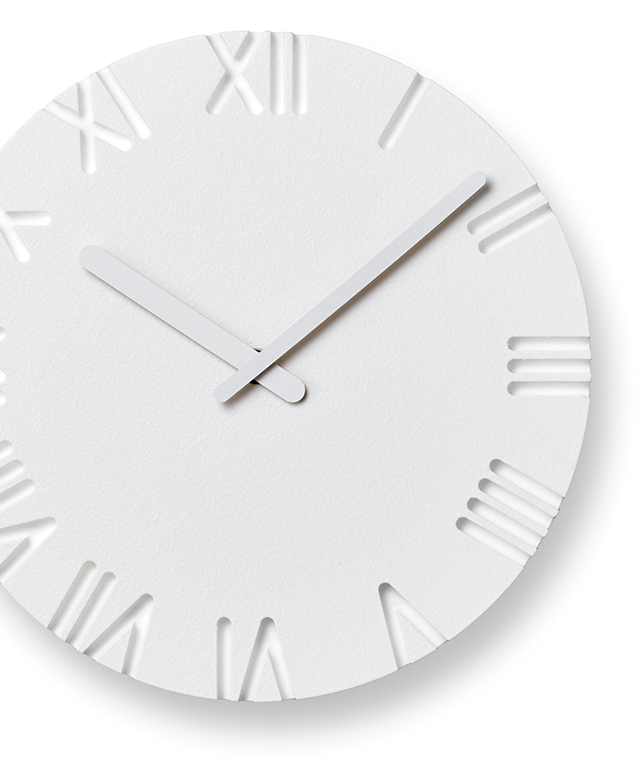
With work efficiency in mind, machined with a single drill
With work efficiency in mind, machined with a single drill
Inorganic artificial wood is very light and easy to process while having a plaster-like feel. If a material were to be heavy, it may cause an accident. In addition, high workability leads to a cost reduction. For these reasons, I considered it best for a wall clock.
With this material in mind, I immediately began working on the design. Since the theme was “texture” on this occasion, I needed a design that would enable me to make a direct expression using a processing method most suitable for the inorganic artificial wood.
When this material is used at a construction site, the basic process is performed at the factory, so only installation is required at the site in most instances. Thus, based on the design image data submitted, the factory produces components using a cutting machine equipped with Numerical Control (NC) machining technology. The rotating drill bit moves to trace the shape of the design image based on the numerical values inputted by the computer.
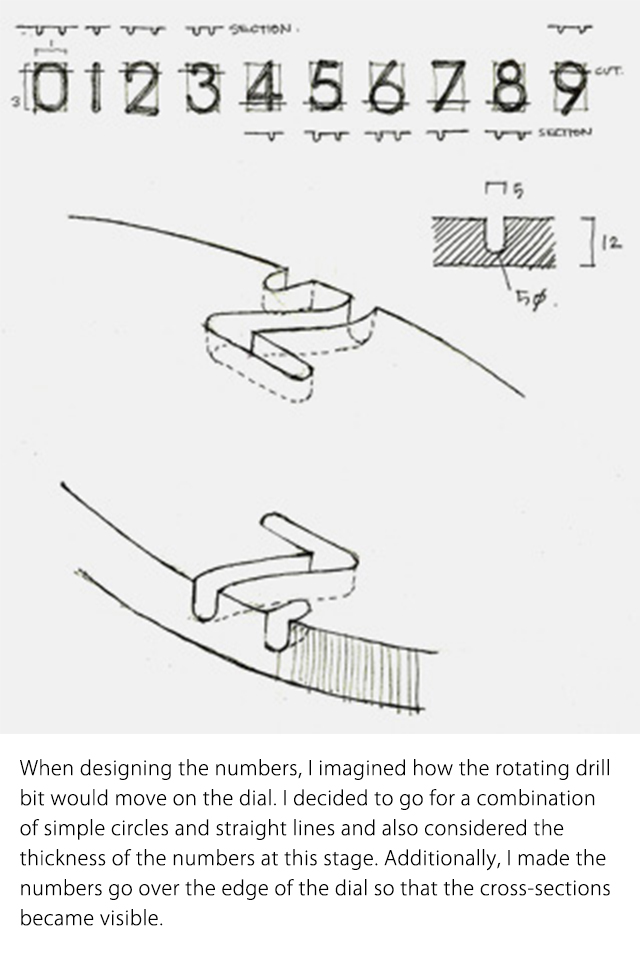
Various types of data are submitted to the factory. If 3D data is submitted, the factory can use it as it is. If 2D drawings made using, for example, Adobe Illustrator are submitted, the factory then converts them for a cutting machine. I adopted the latter method for these clocks.
The first thing I considered was what I could do when machining a shape with a rotating drill bit.I then decided to use only one drill when cutting out the indexes from a plate through the NC machining process.Using many types of drills in different sizes will decrease production efficiency, and a thin drill will break easily, which is inconvenient.
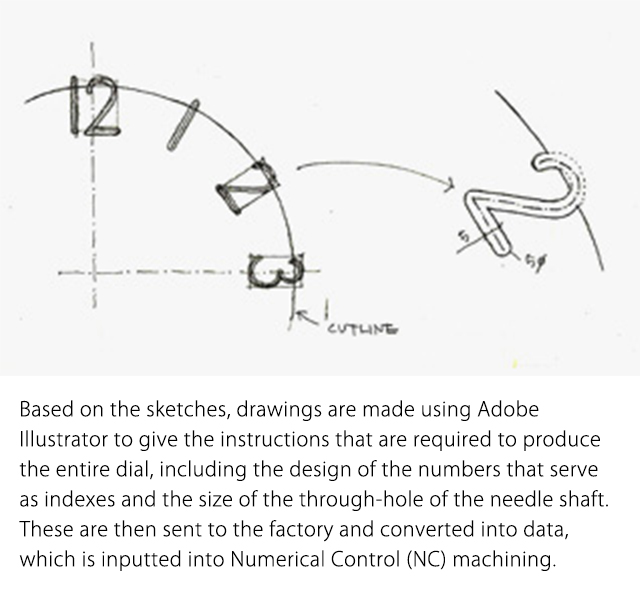
On this occasion, I used the most efficient drill bit with a diameter of 5 mm and rounded all corners into a semicircle to design a typeface that allows numbers to be engraved. I also set the line weight to 5 mm to minimize the cutting length and time spent using the drill bit.
Thus, I decided the direction the dial design was taking. Yet, there were other countless matters to consider, including a balance between the dial size and numbers, the aspect ratio of the numbers, and the engraving depth. A simple, plain dial meant that a slight change in size or shape would have a significant impact on the balance, so I proceeded with this task carefully, spending a lot of time on it.

Naoki Terada
Architect/designer
After graduating from the Department of Architecture, Faculty of Engineering at Meiji University, Naoki Terada gained professional experience in Australia before relocating to the United Kingdom. In 1994, he completed his studies at the Architectural Association School of Architecture. Upon returning to Japan, he founded Terada Design, a first-class registered architect office. His practice encompasses architecture, interior design, and product design, and is characterized by a multidisciplinary approach. From 2018 to 2024, he served as President and Chief Executive Officer of Interoffice Inc. He has received numerous prestigious awards, including the Good Design Award. He has served as a juror for major international design awards such as the Good Design Award (Japan), the iF Design Award (Germany), and the DFA Design Award (Hong Kong).
His publications include The 1/100 World Made of Paper: How to Enjoy Terada Mokei and The 1/100 Stories Made of Paper: The Complete Guide to Terada Mokei (both published by Graphic-sha), as well as Modern Furniture History (published by Seigensha). He is currently Professor at Musashino Art University, Visiting Professor at Tokyo University of Technology, and Part-time Lecturer at Tama Art University.
At TAKATA Lemnos, he is responsible for the brand direction and design of the “15.0% Ice Cream Spoon.”
https://www.teradadesign.com/
https://www.teradamokei.jp/en
https://naokiterada.com/